
Puppy Training
Raising a puppy can be a daunting and exhausting task but it doesn't have to take over your life. Learn the skills to help your puppy grow up to be the companion you've been looking for!
Things we can work on
- Nipping
- Barking
- Chewing
- Leash skills
- Basic obedience
- Socialization
- Potty training
- Enrichment
We'll work together to help set your puppy up for success in any situation. Puppy training offers you an opportunity to learn the right approach for educating and socializing your pup. We will instill lifelong habits that will make your puppy a happy and healthy dog.
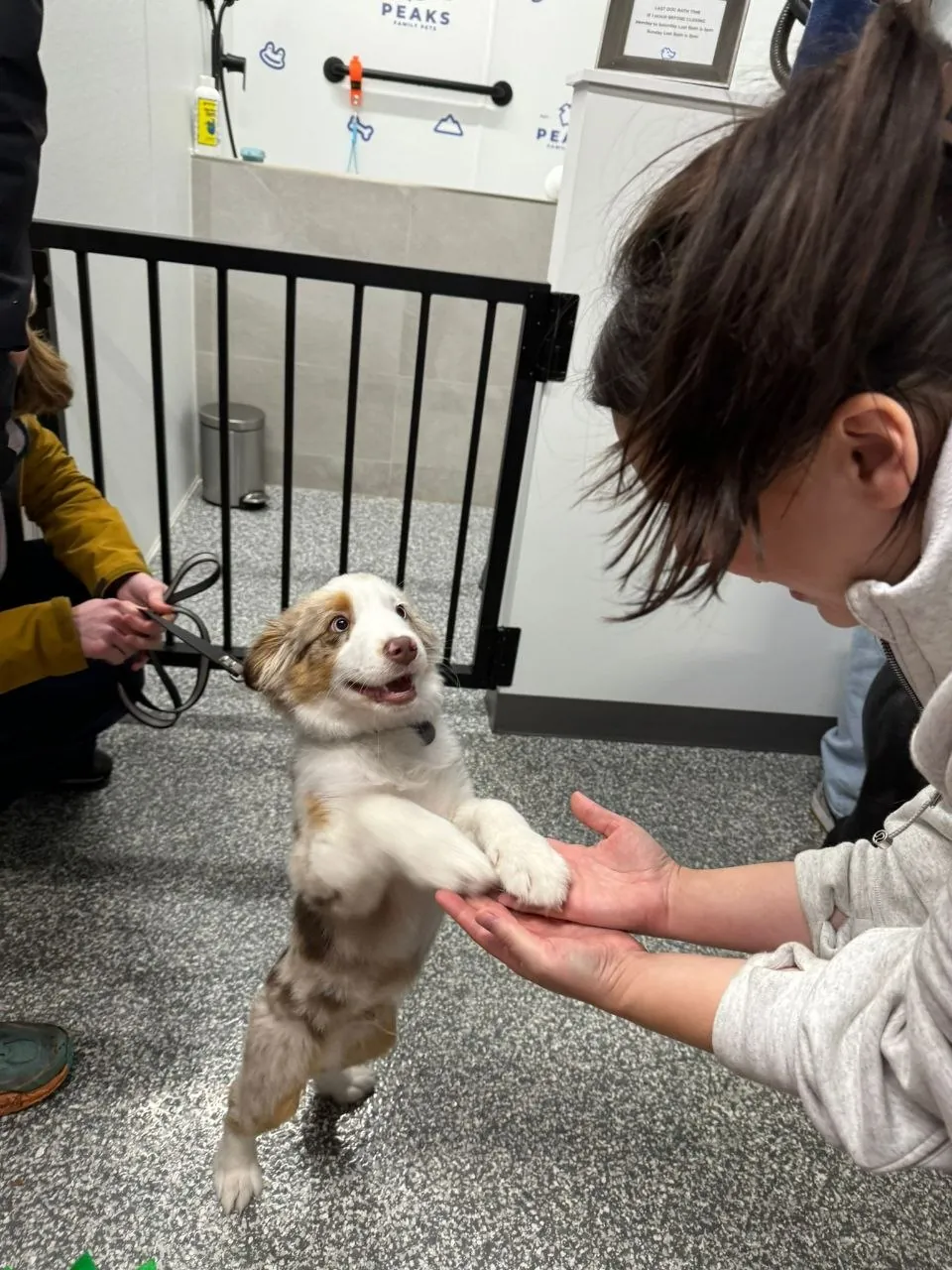
In short
The window that shapes your puppy's adult temperament is open now and it closes early. Socialisation means good experiences at a distance your puppy can handle, not meeting every dog and person you pass. Most of what you do in the first few months is not obedience at all. It is teaching a baby animal that the world is safe.
The window that matters
The most important period for socialisation runs from roughly three to fourteen weeks of age. The American Veterinary Society of Animal Behavior describes the first three months as the primary window, because it is the stretch where a puppy's sociability outweighs their fear. Experiences land differently during that period than they do later.
Miss it and you do not get it back. Incomplete socialisation in those weeks raises the risk of fear, avoidance and aggression in the adult dog. That is not a scare tactic. AVSAB notes that more deaths in dogs under three years old are attributed to behaviour problems than to infectious disease.
The vaccination question
Most owners are told to keep the puppy home until the vaccine course is finished. By then the window has largely closed.
AVSAB's position is that puppies should be socialised before they are fully vaccinated, and that this should be the standard of care. Its guidance is that puppies can begin socialising, including in puppy classes, from around seven to eight weeks, after one set of vaccinations and provided they show no signs of illness.
In practice that means being thoughtful rather than housebound. Carry your puppy through a busy area. Sit on a bench and let them watch the world. Invite calm, vaccinated adult dogs to your home. Avoid dog parks, pet shop floors and anywhere unknown dogs toilet. If you have any doubt about what is appropriate for your puppy, ask your vet, since they know your puppy's health history.
Socialisation is not meeting everyone. A puppy dragged over to greet every dog on the seawall learns that other dogs are wildly exciting and that you are irrelevant. Worse, one bad greeting at eight weeks can leave a mark that takes months to undo. Watching calmly from a distance is usually the better exposure.
Why we usually start at ten weeks
We recommend that puppies are at least ten weeks old before their first session. Younger than that, they are typically only days into a new home, having just left their mother, littermates and every familiar smell. Adding a stranger and a training session to that week is a lot to ask.
That does not mean the first fortnight is wasted. It is when the most valuable socialisation happens, and it is work you can do yourself. Book the session for when your puppy has settled, and use the days before it letting them experience the world gently.
What we work on
Nipping, chewing, barking and toileting are the four that drive owners to the phone, and they are usually the easiest to shift once you understand what is driving them. Puppies bite because they are puppies. Chewing is teething and boredom. Most house training problems are supervision problems.
Beyond that, we work on leash skills before pulling becomes a habit. On recall, while your puppy still wants to be near you. On settling, so that calm is something they can do on cue. And on handling, so vet visits and nail trims are not a fight in a year's time.
We use reward-based methods throughout. AVSAB's 2021 position statement on humane dog training recommends them for all training, and specifically advises against electronic collars, prong collars, choke chains and leash corrections. A puppy learning that hands predict good things is a dog you can handle for the next fifteen years.
What is normal, and what is not
A great deal of what worries new owners is simply development. Lea's article on puppy training progress walks through the stages, from the neonatal period to adolescence, and knowing which stage your puppy is in makes their behaviour far less mysterious. Teething and chewing arrive around three to six months. A second chewing phase often turns up between seven and nine months, along with a puppy who suddenly forgets everything they knew.
What is worth raising sooner rather than later: a puppy who freezes or panics rather than bouncing back, one who cannot be left alone at all, or one whose biting is hard and persistent past the usual stage. Those are easier to help at four months than at fourteen.
Where we work
Sessions happen in your home, which is where most puppy problems actually occur, and outward from there as your puppy is ready. Training covers North Vancouver, West Vancouver, Vancouver, Burnaby, Coquitlam and New Westminster, with online sessions available across Canada. Online works better for puppies than people expect, since so much of the early work is about what you do between sessions.
Common Questions
How old should my puppy be before we start training?
We normally recommend that puppies be at least 10 weeks old or older before starting the training. This is because puppies younger than this tend to be just settling into their new homes so we don't want to add any extra stress to their transition.
How long should I wait between bookings?
We normally recommend leaving about two weeks between bookings so you have enough time to put in place the training routines we'll be working on. However, if you'd prefer to wait longer between training sessions, that's totally fine too!
Do you charge extra for more than one dog in the home?
Nope! The price includes as many dogs as you have in your home. You will not be charged extra for extra dogs.
Related reading

Frustrated With Your Puppy's Training Progress?
The 5 stages of puppy development, and why being patient gets easier when you know the stage.
Read article →
Do Dogs Feel Guilt?
What your puppy is actually feeling when you come home to a chewed slipper.
Read article →
Life Skills
Build the skills to help you and your dog navigate the world confidently and cooperatively.
View details →